
Nucleosides are N-glycosides of ribose and deoxyribose; the N comes from the purines and pyrimidines we examined on another page.
Nucleosides are the basic building blocks of nucleic acids: ribonucleic acid (RNA) and deoxyriboneculeic acid (DNA).
Net, they are formed by the loss of water from a sugar plus a purine or pyrimidine, OH from the anomeric position of the sugar, and H from a nitrogen of the base.
Here are the structures of those based on purines:
| Adenosine | Guanosine |
|---|---|
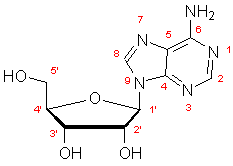 |
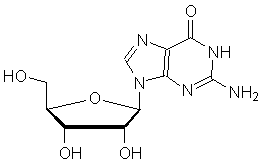 |
| Deoxyadenosine | Deoxyguanosine |
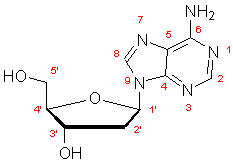 |
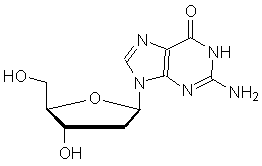 |
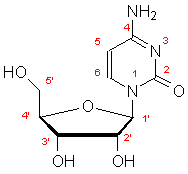
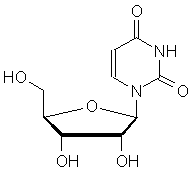
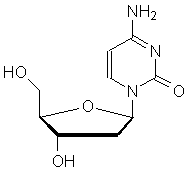
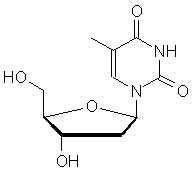
And here are the pyrimidine-based structures:
| Cytidine | Uridine |
|---|---|
 |
 |
| Deoxycytidine | Thymidine (Deoxythymidine) |
 |
 |
One exception to the glycosidic structure of nucleosides is pseudouridine (found in tRNA):
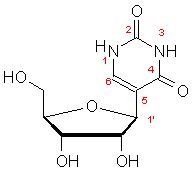
in which C5 of the pyrimidine ring is attached directly to C1' of the sugar.
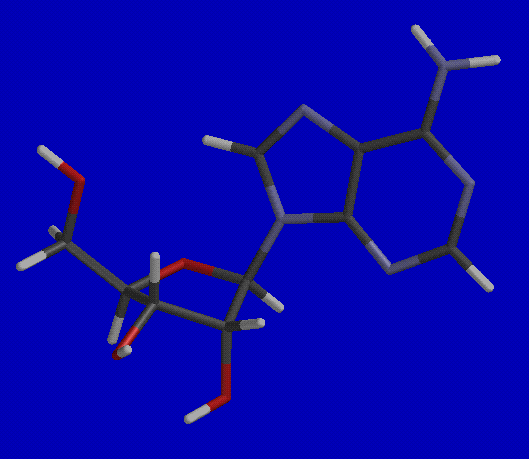
Structural issues: two conformational variations are possible: rotation around the base-to-sugar bond, and puckering of the sugar ring. Consider the two structures below for adenosine:
| Anti-conformation | Syn-conformation |
|---|---|
 |
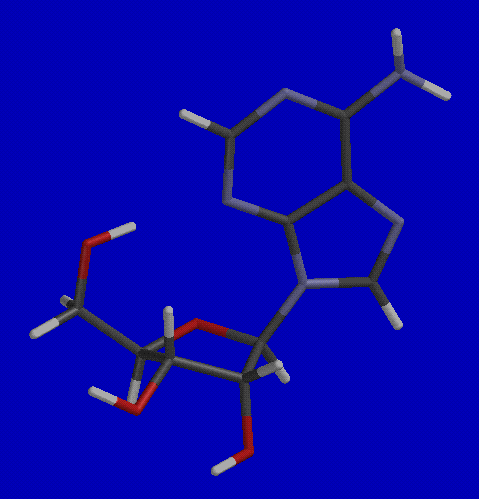 |
In order for base-pairing to occur in a nucleic acid, the anti- conformation is required. But how about for the nucleotide itself?
-
The structures above were produced by low-level ab initio MO calculations, and these find the syn- isomer to be more stable by a couple of kcal/mol, largely on the basis of a hydrogen bond between the 5' OH and a ring nitrogen.
Textbooks say that for purine bases, the syn- and anti- are in equilibrium, but pyrimidines exist entirely in the anti- conformation. This seems counter-intuitive.
The puckering of the sugar ring usually involves having either C2' or C3' out of the plane formed by C1', O, and C4'.
-
If C2' or C3' is on the same side of the ring as the glycosidic bond, the conformation is described as endo-; if on the other side, it is exo-.
Numerous papers discuss the factors involved in one preference or the other, but in general, the two conformations are in equilibrium in solution.
Nucleotides are phosphate esters of nucleosides.
-
Most commonly, the phosphoryl group is attached to the oxygen of the 5'-hydroxyl
-
Nucleotides are typically assumed to be 5'- unless otherwise stated.
-
Monophospates can be further phosphorylated to produce di- and tri- phosphates, as illustrated below for adenosine:
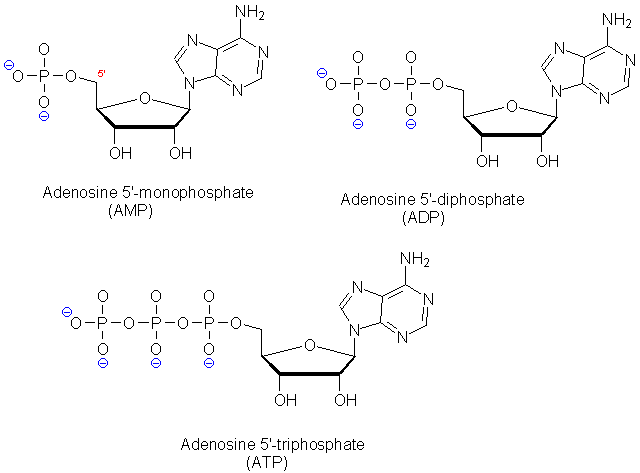
At physiological pH, the phospates are ionized, as depicted in the picture.
In nucleic acids, the 5' phosporyl is esterified to the 3' OH of the next sugar, forming a sugar phosphate backbone, from which the purine and pyrimidine bases extend.
The ionization of the phospates means that RNA and DNA bear multiple negative charges - they are polyelectrolytes. This in turn means that cations of various kinds, especially Mg++, tend to cluster near the phosphates.


